Designing an LNG pump system or cryogenic pump system means dealing with difficult fluids, low temperatures, and tight uptime targets. Traditional crankshaft triplex pumps are common, but they bring high plunger speeds, sinusoidal motion, and heavy cyclic loading that impact seal life, valves, and overall operating cost.
Oilgear’s Transfer Barrier Pump takes a different approach. It is a hydraulic barrier pump that uses an HPU to drive two large, slow-speed plungers for LNG, liquid gas, and other harsh media, with variable delivery and reduced output ripple versus crankshaft technology.
How the Oilgear Transfer Barrier Pump Works
The patented Oilgear Transfer Barrier Pump starts with a hydraulic power unit that generates hydraulic power for the system. Flow from the HPU is precisely controlled and used to drive two large, slow-moving pumping plungers, instead of using a mechanical crankshaft and connecting rods.
That architecture matters for LNG pumps and cryogenic pumps because:
- Plunger motion is controlled hydraulically, not locked to a sinusoidal crank profile.
- Plunger speed can be kept low, reducing seal travel and cyclic loading.
- Delivery is variable, so flow can be adjusted to match process conditions.
The same concept extends to other high-pressure reciprocating pump systems where pressure can reach 1000 bar or more and the fluid can be difficult, multi-phase, or temperature-sensitive.
Key Advantages vs Crankshaft Triplex Pumps
The Oilgear material highlights three main reasons to choose a Transfer Barrier Pump instead of a crankshaft triplex pump: longer life, better control, and flexible packaging.
1. Longer service life from reduced solicitation
Because the plungers are driven hydraulically and move more slowly, seals and valves see lower solicitation and shorter travel distances per minute than in a high-speed triplex pump. The reference deck calls out “solicitations divided by 10” and links this to extended seal and valve life and reduced OPEX.
In contrast, crankshaft pumps often operate with high plunger velocity, sinusoidal motion, and frequent valve cycling, which increase fatigue, heat generation, and wear, especially in harsh fluids.
2. Precision, variable delivery, and reduced ripple
The Transfer Barrier Pump is described as variable displacement with very reduced output ripple versus crankshaft technology. Oilgear cites about a 20% efficiency gain compared to mechanical pumps in similar service, which directly affects cost of ownership and time required per unit of transferred volume.
For LNG pump systems and liquid gas transfer systems, that means:
- Adjustable delivery flow instead of fixed delivery.
- Smoother ramp-up and lower shock in the hydraulic circuit.
- Reduced need for accumulators and other pulsation-control hardware in some layouts.
3. Flexible pump skid and system packaging
Because the pump is hydraulically driven, the skid does not have to follow a straight mechanical line from motor to crankshaft. The system is broken into four main parts: the hydraulic HPU, two cylinder assemblies with inlet and outlet poppets, the electrical enclosure and controls, and the process equipment around the cold end.
This enables:
- LNG pump skids that fit existing footprints in retrofit projects.
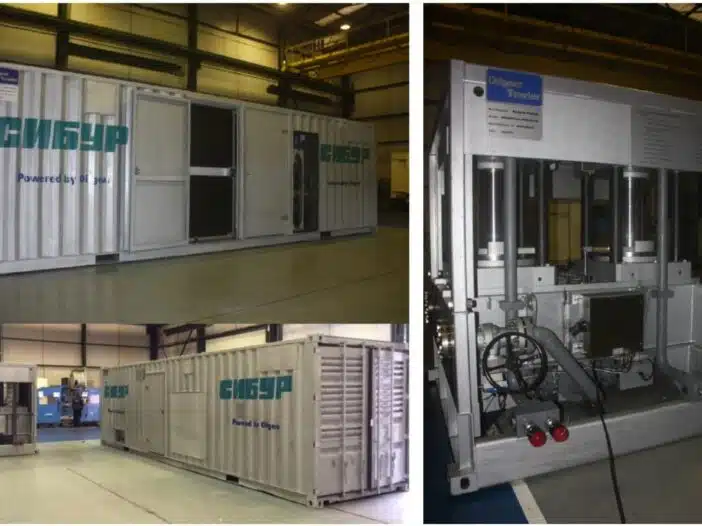
- Containerized or transportable pump systems where the HPU and electrics are located remotely from the cold end.
- Easier integration into constrained layouts in pipeline maintenance, terminals, and industrial plants.
LNG and Cryogenic Application Example
One application in the Oilgear documentation shows the Transfer Barrier Pump used as an LNG transfer pump for pipeline maintenance.
Key data from that LNG pump system:
- Pumped media: liquefied natural gas with a wide fraction of light hydrocarbons.
- Fluid temperature: about -2 °C to +5 °C.
- Inlet and outlet pressures: 5 to 60 bar.
- Requested flow: 3000 L/min at 60 bar, with adjustable delivery from 200 to 3000 L/min.
- On-site achieved flow: approximately 3024.45 L/min.
- Ambient temperature: down to about -40 °C, with ATEX Zone 2 IIB T4 conditions.
The equipment is shown as a transportable unit designed to be deployed anywhere along a 30 km pipeline with a diameter of 700 mm. The purpose is to empty gas pipelines for maintenance and perform LNG transfer safely and efficiently under varying environmental conditions.
This example makes the Transfer Barrier design relevant for searches such as “LNG pump skid,” “pipeline LNG transfer pump,” “cryogenic transfer pump,” and “transportable LNG pump unit.”
Hydraulic Power Unit and Cold Start Strategy
The hydraulic power unit for the Transfer Barrier system is more than a simple pump and tank. Oilgear lists a cold start strategy that includes:
- A Webasto system for heating support.
- Hydraulic fluids selected for low-temperature operation.
- Ether injection for cold diesel engine starts.
- Low-temperature rated equipment and components.
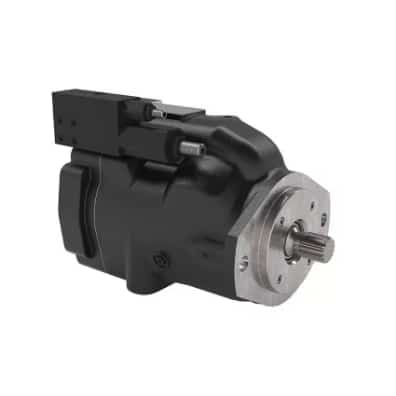
Main HPU components include a diesel engine around 470 kW, Oilgear variable displacement pumps, an electric generator, air/oil heat exchangers, a main oil tank, a main manifold, a diesel tank, and an electric cabinet. This configuration supports mobile or remote LNG pump systems where grid power is not available and low ambient temperatures are common.
Integrated Controls, HMI, and Remote Operation
Control and monitoring are critical on any high-pressure reciprocating pump skid, especially in LNG and cryogenic applications. Oilgear’s Transfer Barrier Pump system includes integrated electrical controls, a touchscreen HMI, and a remote control box.
The touchscreen control panel provides:
- Indication of flow and pressure.
- Start and stop commands for motors.
- An interactive hydraulic circuit display.
- Fault and default control information.
- Parameter optimization for the pump system.
The remote control box, with a cable length of about 50 meters, offers flow control, start, stop, and emergency stop functions. This is important for LNG pump systems and cryogenic pump systems that need local and remote operation modes during pipeline maintenance or loading operations.
Proven Performance in Harsh Conditions
Oilgear lists several proof points for the Transfer Barrier technology:
- Pumping liquid gas since approximately 2015 in continuous-duty applications.
- Use at pressures up to 1000 bar or more.
- Capability in large flow rates, harsh fluids, varying densities, and wide temperature ranges.
- Application in multi-phase flow and fluids.
An acceptance test dated 16/02/2016 shows performance data for a system handling LNG with inlet pressures around 6–8 bar, using AMG-10 hydraulic fluid, reaching maximum output flow above 3000 L/min and maximum output pressure of 38 bar at the test site. No leaks were observed during the test, and operation took place at around -20 °C ambient temperature.
These details support SEO phrases like “proven LNG pump technology,” “high-pressure LNG pump,” “hydraulic barrier pump for liquid gas,” and “cryogenic pump system with high flow capability.”
When to Consider a Transfer Barrier Pump System
Triplex and quintuplex crankshaft pumps will remain common in many installations, but the Transfer Barrier Pump system is designed for cases where:
- High plunger velocities, cyclic stress, and short seal life are driving maintenance cost.
- Pulsation, shock, and fatigue are a concern in the pump circuit.
- Variable delivery and tight flow control are important for LNG transfer or cryogenic processing.
- Skid footprint and packaging constraints make a fixed mechanical layout difficult.
- Very high pressures or difficult fluids push conventional designs toward their limits.
In those scenarios, a hydraulically driven Transfer Barrier Pump provides a different starting point for system design: controlled plunger motion, variable displacement, reduced output ripple, and more flexible pump skid packaging, supported by a dedicated hydraulic power unit and integrated electrical controls.