Surprise hydraulic failures rarely come from nowhere. In almost every case, the system was giving signals long before the press stopped. The difference between organizations that live in emergency mode and those that do not is not luck—it is how intentionally they look for, interpret, and act on those signals.
The first step is deciding where to focus attention. Service teams that reduce emergency callouts start by identifying which presses create the most disruption when they fail. Not all assets deserve the same level of scrutiny. Priority goes to presses that drive overtime, miss shipments, or depend on long-lead replacement parts. Once that short list is clear, effort becomes focused instead of diluted.
From there, effective teams establish a baseline of normal operation. This step is often overlooked, yet it is foundational. Without a clear understanding of normal pressures, temperatures, cycle times, and alarm behavior, technicians are forced to react after something breaks. Baselines do not need to be complex—just consistent. Recording steady-state temperatures, pump outlet pressures, valve response times, and cycle durations provides a reference that immediately highlights abnormal drift.
The next critical area is fluid condition management. Fluid is the common denominator across pumps, valves, and actuators, yet it is often treated as a consumable rather than a system component. Teams that consistently reduce surprise failures use fluid health as an early warning system, recognizing that rising contamination, water content, or varnish formation typically appears months before functional breakdowns occur. Routine sampling, trend analysis—not simple pass/fail reporting—and clear ownership for corrective action turn oil analysis into a preventive tool instead of paperwork. As one Oilgear service technician put it,
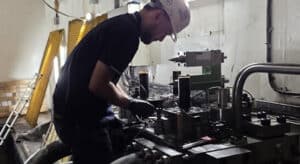
“From on-site experience, something as simple as keeping the oil clean has a direct impact on reliability—presses that once needed frequent emergency callouts for leaking or sticking valves across the manifolds start running longer between issues, allowing visits to shift from constant troubleshooting to planned preventive maintenance.” Cliff Howie, Oilgear Service Technician
Closely linked is thermal behavior. Excess heat accelerates wear, reduces lubrication margins, and destabilizes control behavior. Instead of reacting to high-temperature alarms, disciplined teams monitor average operating temperatures and how quickly heat builds during long runs. When temperatures slowly climb over weeks, it is often a sign of internal leakage, cooling degradation, or increased load—not a random event. Addressing these trends early prevents cascading failures.
Another common blind spot is the pilot and control circuits. Many failures attributed to “bad valves” originate in unstable pilot pressure, contaminated control oil, or drifting sensors. Service teams that reduce emergency work routinely verify pilot pressures, inspect filtration specific to control circuits, and validate feedback signals. These checks are fast, low-cost, and disproportionately effective at preventing unpredictable behavior.
Change management also matters. A surprising number of failures follow recent maintenance, tuning adjustments, or operating changes that were not fully documented. Teams that reduce callouts establish simple rules: any change to components, settings, or operating parameters gets logged and reviewed if performance shifts. This practice turns “mystery failures” into traceable cause-and-effect events.
Finally, organizations that escape reactive mode close the loop after every event. Instead of replacing the failed part and moving on, they ask one question: what warning did we miss? Over time, this discipline reduces true surprises.
Reducing surprise hydraulic failures is not about perfect systems. It is about seeing patterns early, acting deliberately, and refusing to normalize small abnormalities. When service teams operate this way, emergency callouts become the exception—and reliability becomes predictable.
Partnering Through Engineering Precision
Reducing hydraulic failures isn’t just about maintenance—it’s about building systems and partnerships that prevent problems before they start. The most reliable operations catch small shifts early, make data-driven adjustments, and turn maintenance from a cost center into a source of performance stability.
Oilgear brings decades of experience in high-force press systems and complex hydraulic controls to help manufacturers engineer reliability throughout their operation. By combining hands-on field expertise with advanced diagnostics, our teams focus on what matters most—fluid health, stable pilot circuits, optimized controls, and predictable performance.
We don’t just fix problems; we help you understand root causes and prevent them from returning. Through close collaboration with maintenance and engineering teams, tailored reliability programs reduce emergencies, increase uptime, and give confidence that hydraulic performance can be counted on—every cycle.